

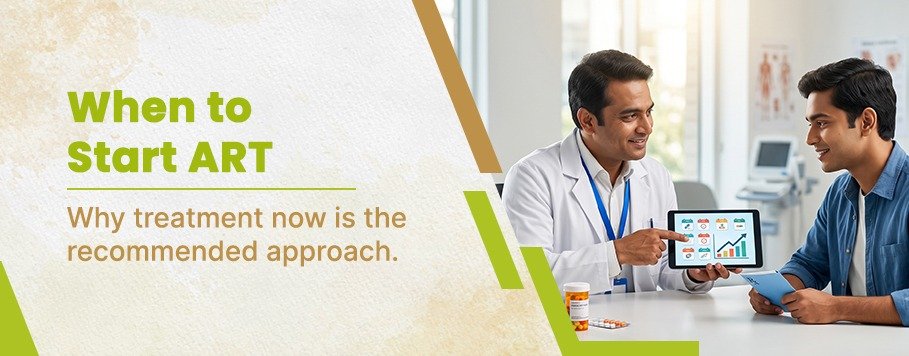
After an HIV diagnosis, one of the first and most important questions is: when should treatment start? For years, the answer was complicated and often meant waiting. Today, the guidance is refreshingly simple: start as soon as possible. This guide explains when to start ART, the “treat-all” approach behind that advice, and why starting early is so beneficial.
If you or someone you know has just been diagnosed, understanding this can help you take the most protective step quickly and confidently.
Quick Summary / Key Takeaways
|
Modern guidelines, including those from the WHO and followed in India, recommend starting ART as soon as possible after an HIV diagnosis. There is no need to wait until you feel unwell or until your immune count drops to a certain level. This is a major shift from older advice, and it is covered in our complete guide to HIV treatment in India.
| What is the treat-all approach? The treat-all approach means that everyone diagnosed with HIV is offered treatment straight away, regardless of their CD4 (immune) count or whether they have symptoms. It replaced older guidance that had people wait until their immune system had already weakened. Treat-all is now the global standard. |
In the past, treatment was sometimes delayed until the immune system showed signs of decline. Research changed that thinking. Studies showed clearly that starting ART early leads to better health outcomes and helps prevent both HIV-related and other illnesses. Waiting, by contrast, allowed avoidable damage to build up. So the guidance moved to treating everyone, as soon as they are ready.
No. Under the treat-all approach, you do not need to wait for a particular CD4 (immune) count before starting. Your doctor will still check your CD4 count and viral load as part of baseline testing, but these results guide monitoring rather than delay treatment. Baseline tests are arranged through HIV lab testing.
| Benefit | Why it matters |
|---|---|
| Protects the immune system | Prevents damage before it can build up |
| Better long-term health | Linked to fewer HIV-related and other illnesses |
| Reaches undetectable sooner | Earlier suppression of the virus |
| Prevents onward transmission | An undetectable viral load means HIV is not passed on sexually |
| Peace of mind | Taking action early can ease worry |
That transmission benefit is worth underlining: reaching an undetectable viral load means HIV is not passed on sexually, the principle of Undetectable = Untransmittable (U=U). Starting early helps you get there sooner.
This is one of the most common reasons people hesitate, and it is completely understandable. Many people feel perfectly well when diagnosed. But HIV works silently, quietly affecting the immune system long before any symptoms appear. Starting treatment while you feel healthy is exactly what keeps you healthy. Feeling well is the best time to protect your future, not a reason to wait.
Starting ART is straightforward. After baseline tests, your doctor selects a regimen suited to you, often a single daily tablet, as explained in first-line ART regimens explained. You begin taking it, attend follow-up visits, and your viral load falls over the following weeks and months. To understand the medicine itself, see what is ART (antiretroviral therapy).
| Myth | Fact |
|---|---|
| You should wait until you feel unwell to start ART. | Guidelines recommend starting as soon as possible after diagnosis. |
| You must wait for your CD4 count to drop. | Under treat-all, treatment starts regardless of CD4 count. |
| Starting early means more side effects for no reason. | Starting early protects health; modern ART is well tolerated. |
| If I feel fine, treatment can wait. | HIV works silently; starting while well is what keeps you well. |
| Delaying treatment keeps options open. | Delay allows avoidable damage; early treatment is clearly better. |
| When to Consult a Doctor Speak to a doctor as soon as possible after an HIV diagnosis so treatment can begin promptly. Also reach out if you have questions about starting, concerns about side effects or cost, or other health conditions to consider. There is no benefit to delaying. When in doubt, consult an HIV specialist or healthcare professional. |
The answer to “when should I start ART?” is now clear and encouraging: as soon as possible. The treat-all approach means everyone with HIV is offered treatment straight away, without waiting for symptoms or a particular CD4 count. Starting early protects your immune system, improves long-term health, and helps you reach an undetectable viral load sooner.
If you have been diagnosed, starting treatment promptly is the most protective step you can take. TAAL+ Healthcare offers HIV treatment & ART care and a confidential HIV doctor consultation to help you begin without delay.
As soon as possible. Current guidelines, including those from the WHO and followed in India, recommend starting treatment straight away, regardless of how well you feel or your CD4 count. There is no benefit to delaying.
Treat-all means everyone diagnosed with HIV is offered treatment immediately, regardless of their CD4 count or symptoms. It replaced older guidance that had people wait until their immune system had already weakened, and it is now the global standard.
No. Under the treat-all approach, treatment starts regardless of CD4 count. Your doctor still checks your CD4 count and viral load at baseline, but these guide monitoring rather than delay the start of treatment.
Research showed that starting ART early leads to better health outcomes and helps prevent both HIV-related and other illnesses. Waiting allowed avoidable damage to build up, so guidance moved to treating everyone as soon as possible.
Yes. Many people feel well when diagnosed, but HIV works silently, affecting the immune system before symptoms appear. Starting treatment while you feel healthy is exactly what keeps you healthy.
Early treatment protects the immune system before damage builds up, improves long-term health, helps you reach an undetectable viral load sooner, and once undetectable, means HIV is not passed on sexually.
After baseline tests, your doctor selects a regimen suited to you, often a single daily tablet. You begin taking it, attend follow-up visits, and your viral load falls over the following weeks and months.
In most cases treatment starts promptly, but your doctor may occasionally consider timing for specific medical reasons. For the vast majority of people, starting as soon as possible is best.
 +91 98925 15959

Before You Go
The HIV Test Kit Is Still FREE
A private HIV self-test, delivered in plain packaging. Result in 20 minutes, at home. No cost, no clinic visit, and a TAAL+ doctor on call whichever way it goes.
Offer valid only in India till 30 September 2026. T&Cs apply.