

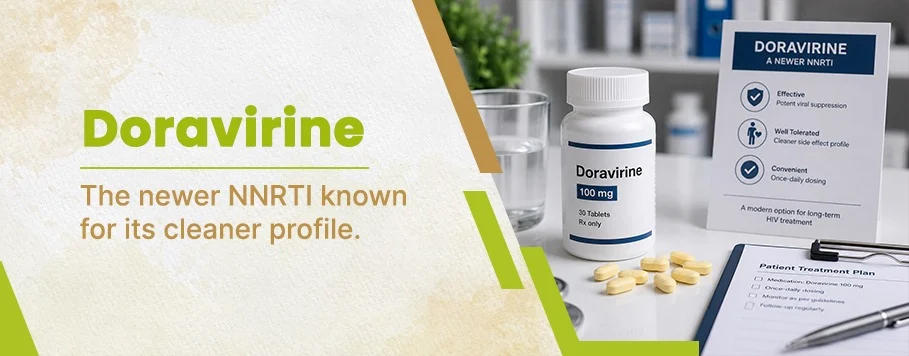
Doravirine is a newer member of the NNRTI class, developed to offer the benefits of that class with a more favourable profile than older options. This guide explains what doravirine is, how it works, how it compares with earlier NNRTIs such as efavirenz, and the points a treating doctor keeps under review.
Doravirine is sometimes abbreviated to DOR, and it is available both on its own and within a single-tablet regimen.
| Important note This article is general information about medicines used in HIV care. It does not include dosing instructions and is not a substitute for medical advice. All HIV medicines are prescription-only and are selected, started, and changed by a qualified doctor. |
Quick Summary / Key Takeaways
|
Doravirine is a newer member of the NNRTI class, developed to offer the benefits of that class with a more favourable profile than older options. Doravirine is sometimes abbreviated to DOR.
Doravirine belongs to the NNRTI class described in the guide to NNRTIs: efavirenz and nevirapine. Like others in the class, it attaches to reverse transcriptase and changes its shape so the enzyme can no longer function.
Doravirine was developed to address some of the considerations associated with earlier NNRTIs. Compared with efavirenz, it is generally associated with fewer nervous system effects and a more favourable effect on cholesterol measures.
| Feature | Doravirine | Efavirenz |
|---|---|---|
| Class | NNRTI | NNRTI |
| Nervous system effects | Fewer reported | More commonly reported |
| Effect on cholesterol | Generally favourable | Less favourable |
| Single-tablet option | Available | Available |
| Place in treatment | A newer option | Long established |
For most people starting treatment today, current guidance points to regimens built around dolutegravir, as set out in first-line ART regimens explained.
Doravirine is generally well tolerated. Where effects occur, they are usually mild and may include nausea, headache, dizziness (generally less often than with older NNRTIs), and unusual dreams or sleep changes (generally less often than with older NNRTIs).
| Myth | Fact |
|---|---|
| Doravirine can be taken on its own. | It is used in combination as part of a complete regimen. |
| All NNRTIs have the same side effects. | Doravirine has fewer nervous system effects than older NNRTIs. |
| Newer means less studied and less reliable. | Doravirine is well studied and used within established guidance. |
| Doravirine has no interactions. | Certain medicines lower its levels, so a doctor reviews everything being taken. |
| An NNRTI is always the first choice. | Current guidance prefers dolutegravir-based regimens for most people. |
| When to Consult a Doctor Medical advice is appropriate before starting or changing doravirine, where side effects appear or persist, and where other medicines are being taken that may affect its levels. Support is available through HIV treatment and ART care. |
Doravirine is a newer NNRTI developed to offer fewer nervous system effects and a more favourable effect on cholesterol than older options. While current guidance prefers dolutegravir-based treatment for most people, doravirine provides a useful alternative decided by the treating doctor.
For expert guidance, TAAL+ Healthcare offers HIV treatment & ART care and a confidential HIV doctor consultation.
Doravirine is a newer NNRTI used as part of combination HIV treatment. It blocks reverse transcriptase and was developed to improve on the profile of older NNRTIs.
Doravirine is generally associated with fewer nervous system effects and a more favourable effect on cholesterol. Both are NNRTIs available within single-tablet regimens, and a doctor assesses suitability individually.
It is generally well tolerated. Where effects occur they are usually mild and may include nausea, headache, and dizziness, with nervous system effects reported less often than with older NNRTIs.
Doravirine is available both on its own and within a single-tablet regimen combining it with two NRTIs.
Certain medicines can lower doravirine levels, so the treating doctor reviews everything being taken before starting or changing treatment.
Current guidance prefers dolutegravir-based regimens for most people. Doravirine is a useful alternative where an NNRTI-based regimen is considered suitable.
No. Like all antiretroviral medicines it is used as part of a combination regimen.
Yes. Although it is a newer NNRTI, doravirine is well studied and used within established treatment guidance.
 +91 98925 15959

Before You Go
The HIV Test Kit Is Still FREE
A private HIV self-test, delivered in plain packaging. Result in 20 minutes, at home. No cost, no clinic visit, and a TAAL+ doctor on call whichever way it goes.
Offer valid only in India till 30 September 2026. T&Cs apply.