
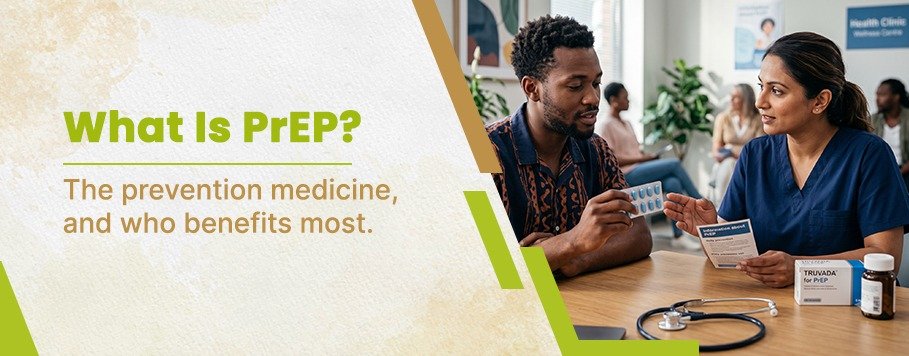
PrEP has quietly become one of the most effective ways to prevent HIV, yet plenty of people are still unsure what it actually is or whether it applies to them. If you have heard the term and wondered ‘what is PrEP, and is it for me?’, this simple guide is for you.
In a few minutes you will understand what PrEP is, how it works, and, most importantly, who benefits from it, so you can decide whether it is worth a conversation with a doctor.
Quick Summary / Key Takeaways
|
What Is PrEP?
PrEP stands for pre-exposure prophylaxis. It is medicine that people who do not have HIV take to protect themselves from getting it. ‘Prophylaxis’ just means prevention, so PrEP is, quite literally, prevention taken before any possible exposure. For the full picture, see our complete guide to PrEP in India.
Important: PrEP is for HIV-negative people
|
How Does PrEP Work?
PrEP keeps a protective level of medicine in your body. If you come into contact with HIV, that medicine stops the virus from establishing an infection. The catch is simple: this protection depends on taking PrEP consistently, as prescribed. Taken regularly, it offers strong protection; taken erratically, protection falls.
Who Should Take PrEP?
PrEP is not limited to any single group. It is worth considering for anyone who is HIV-negative and has an ongoing chance of exposure. You might benefit from PrEP if you:
- Have a partner living with HIV, particularly if they are not yet virally suppressed.
- Have a partner whose HIV status you do not know.
- Have more than one partner, or a partner who does.
- Do not always use condoms and may be at risk.
- Have had a recent STI, or have needed emergency prevention (PEP) before.
- Share injecting equipment.
If any of these sound familiar, PrEP may be a good fit. A clinician can help you weigh it up, and we go deeper in who is eligible for PrEP in India.
Who Might Not Need PrEP?
PrEP is not for everyone. If you have a very low chance of HIV exposure, for instance if you and a partner are both HIV-negative and mutually monogamous, you may not need it. And if a partner living with HIV is on treatment and undetectable, they cannot pass HIV on sexually, which may change the picture. A doctor can help you decide what makes sense for your circumstances.
PrEP at a Glance
| Question | Answer |
|---|---|
| Who is it for? | HIV-negative people with ongoing risk of exposure |
| What does it do? | Greatly reduces the chance of getting HIV |
| How is it taken? | As prescribed, consistently (daily or, for some, on-demand) |
| Does it cover other STIs? | No; condoms still protect against other STIs and pregnancy |
| How do I begin? | Confirm you are HIV-negative, then see a doctor to start |
Is PrEP Right for You?
The honest answer is that only a conversation with a clinician can tell you for sure, because it depends on your life and your level of risk. There is no wrong reason to ask. If you have decided PrEP might be for you, our guide on how to start PrEP step by step walks you through what happens next, beginning with HIV lab testing.
Myths vs Facts: What PrEP Is
| Myth | Fact |
|---|---|
| PrEP is only for certain kinds of people. | PrEP is for any HIV-negative person with potential exposure. |
| PrEP is a cure for HIV. | PrEP is prevention for HIV-negative people, not a cure or treatment. |
| PrEP replaces condoms entirely. | PrEP prevents HIV only; condoms still protect against other STIs. |
| If I feel healthy, PrEP is pointless. | PrEP is about preventing future infection, whatever your current health. |
| Taking PrEP is complicated. | Starting is straightforward: a test, a check-up, and a prescription. |
When to Consult a Doctor
Speak to a healthcare professional if you think PrEP might be right for you, are unsure about your level of HIV exposure, or want to understand your prevention options. If you may have been exposed to HIV in the last 72 hours, seek emergency prevention (PEP) urgently rather than waiting. When in doubt, consult an HIV specialist or healthcare professional.
Conclusion
So, what is PrEP? It is a safe, highly effective medicine that HIV-negative people take to prevent HIV, and it is for anyone with an ongoing chance of exposure, not just a select few. Understanding whether it fits your life is simply a matter of an honest, confidential conversation.
If PrEP sounds like it might be right for you, the next step is easy. TAAL+ Healthcare offers PrEP for HIV prevention and a private doctor consultation to help you decide and start with confidence.
Frequently Asked Questions
What is PrEP in simple terms?
PrEP (pre-exposure prophylaxis) is medicine that HIV-negative people take to protect themselves from getting HIV. Taken as prescribed, it keeps a protective level of medicine in the body so the virus cannot take hold if you are exposed.
Who should take PrEP?
PrEP is for any HIV-negative person with an ongoing chance of exposure, such as having a partner with HIV or of unknown status, multiple partners, inconsistent condom use, a recent STI, or sharing injecting equipment. A clinician can help you decide.
How does PrEP work?
PrEP keeps a protective level of medicine in your body so that if you encounter HIV, it cannot establish an infection. This protection depends on taking PrEP consistently, as prescribed.
Is PrEP only for certain groups of people?
No. This is a common myth. PrEP is for anyone who is HIV-negative and has continuous
chance of HIV exposure, regardless of who they are. What matters is the level of risk, not the group someone belongs to.
Do I still need condoms if I take PrEP?
Yes. PrEP prevents HIV but not other sexually transmitted infections or pregnancy. Using condoms alongside PrEP gives broader protection, so many people combine the two.
How do I know if PrEP is right for me?
The best way is a confidential conversation with a clinician, who can assess your level of exposure and circumstances. There is no wrong reason to ask, and the discussion itself carries no obligation.
Can people already living with HIV take PrEP?
No. PrEP is preventive medicine for HIV-negative people. People living with HIV take HIV treatment instead. This is why starting PrEP always begins with an HIV test to confirm a negative status.
Is it complicated to start PrEP?
Not at all. Starting is straightforward: confirm you are HIV-negative, have a baseline health check, and get a prescription with guidance on how to take it. Regular follow-up then keeps it working safely.


