


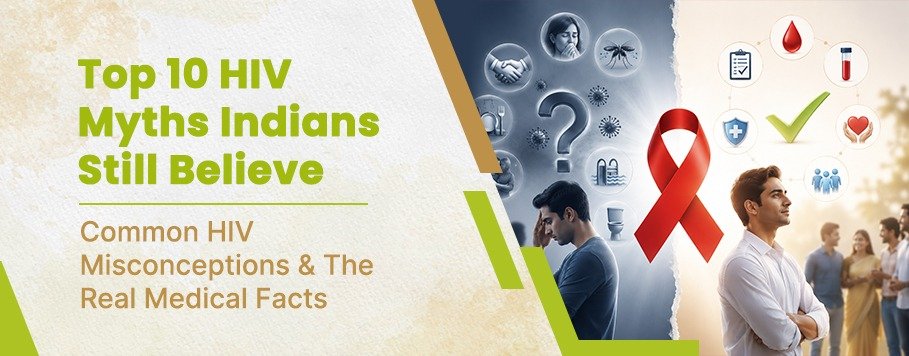
Despite decades of progress in treatment and awareness, HIV in India is still surrounded by myths. These misconceptions do real harm: they fuel stigma, stop people from getting tested, and isolate those living with the virus. Often the myths are not spread out of cruelty, but out of fear and a lack of clear information.
The good news is that the facts are reassuring. HIV is far better understood today than ever before, and most fears that surround it simply are not true. Here are ten of the most common HIV myths still believed across India, and the real, science-backed facts behind each one.
Quick Summary / Key Takeaways
|
Myth 1: HIV and AIDS Are the Same Thing
Fact: They are not. HIV is the virus; AIDS is an advanced stage of untreated HIV infection. With today’s treatment, the vast majority of people living with HIV never develop AIDS at all. Effective HIV treatment and ART care keeps the immune system strong, so HIV stays a manageable condition.
Myth 2: HIV Is a Death Sentence
Fact: This was once a tragic reality, but it is no longer true. With consistent treatment, people with HIV can expect a near-normal life span and good health. Many marry, work, raise families, and grow old. Read more in our blog on whether HIV patients can live normal lives.
Myth 3: You Can Get HIV From Casual Contact
Fact: HIV is not spread by hugging, shaking hands, sharing food or utensils, using the same toilet, or swimming in the same pool. It is carried only in specific body fluids, blood, semen, vaginal and rectal fluids, and breast milk, and needs a real route into the body. Our guide on how HIV spreads explains the actual routes in detail.
Myth 4: Mosquitoes Can Spread HIV
Fact: They cannot. HIV does not survive or multiply inside a mosquito, and mosquitoes do not inject the blood of a previous person when they bite. Despite how common this belief is, there is no evidence anywhere in the world of HIV spreading through insect bites.
Myth 5: You Can Tell Someone Has HIV by Looking at Them
Fact: You cannot. Many people with HIV look and feel completely healthy for years, especially on treatment. The only way to know anyone’s status, including your own, is an HIV test. Judging by appearance only spreads fear and stigma.
Myth 6: Only “Certain Kinds” of People Get HIV
Fact: HIV does not care about caste, class, religion, gender, or marital status. While some groups face higher exposure, anyone who comes into contact with the virus can acquire it, including married people in long-term relationships. Treating HIV as “someone else’s problem” is exactly what allows it to spread unnoticed.
Myth 7: People With HIV Cannot Marry or Have Healthy Children
Fact: They can. With treatment and medical guidance, people with HIV have safe relationships, and serodifferent couples can plan pregnancies. When a partner is on treatment and undetectable, HIV is not passed on through sex, the principle of Undetectable = Untransmittable (U=U). Programmes to prevent parent-to-child transmission also help mothers have HIV-negative babies.
Myth 8: There Is a Herbal or Instant Cure for HIV
Fact: There is no cure for HIV, and no herbal remedy, ritual, or “miracle” product can remove it. Sadly, false cure claims are common in India and can be dangerous, because they lead people to stop proven treatment. What does work is antiretroviral therapy, which controls the virus and protects health when taken daily as prescribed.
Myth 9: If You Feel Fine on Treatment, You Can Stop the Medicines
Fact: Feeling well is a sign the treatment is working, not a reason to stop it. If medicine is stopped, the virus rebounds and health declines. HIV treatment is lifelong, and staying on it is what keeps people healthy and undetectable. If side effects or costs are a problem, a doctor consultation can help find solutions, never stop on your own.
Myth 10: HIV Testing Is Not Private and Will Ruin Your Reputation
Fact: HIV testing in India is confidential, and your results are protected. Fear of exposure keeps far too many people from testing, yet knowing your status early leads to better health and peace of mind. Confidential, judgment-free HIV lab testing is widely available, including private options.
Myths vs Facts: Quick Reference
| Common myth | The real fact |
|---|---|
| HIV and AIDS are the same. | HIV is the virus; AIDS is an advanced stage that treatment usually prevents. |
| HIV is a life-threatening condition | With treatment, people with HIV live long, healthy lives. |
| You can catch HIV from hugging or sharing food. | Casual contact does not spread HIV. |
| Mosquitoes spread HIV. | Insect bites do not transmit HIV. |
| You can spot HIV by appearance. | Only a test can reveal HIV status. |
| Only ‘certain people’ get HIV. | Anyone exposed to the virus can acquire it. |
| HIV-positive people can’t have families. | Safe relationships and healthy children are possible with care. |
| Herbal remedies can cure HIV. | There is no cure; daily ART controls the virus. |
| You can stop medicine when you feel fine. | Treatment is lifelong; stopping lets the virus return. |
| HIV tests are not private. | Testing in India is confidential and protected. |
Why Busting These Myths Matters
Stigma is often more harmful than the virus itself. It pushes people away from testing, treatment, and support, and it isolates those who most need understanding. Every myth corrected is a step towards a kinder, healthier society, and towards India’s goal of ending HIV as a public health threat.
If you have questions or fears about HIV, the best response is accurate information and a safe place to ask. You can also explore our wider myth-busting and HIV education blog.
Conclusion
Most of what people fear about HIV in India is rooted in myth, not medicine. HIV does not spread through everyday contact, it is not a life-threatening condition, and it cannot be judged by appearance or cured by shortcuts. What is true is far more hopeful: with testing, treatment, and compassion, people living with HIV lead full, healthy lives.
Replacing fear with facts protects everyone. If you would like to learn your status or talk through any concern in private, TAAL+ Healthcare offers confidential HIV testing and confidential doctor consultations without judgment.
Frequently Asked Questions
Can you get HIV from casual contact like hugging or sharing food?
No. HIV is not spread through hugging, shaking hands, sharing food or utensils, toilets, or swimming pools. It is carried only in specific body fluids and needs a genuine route into the body.
Can mosquitoes spread HIV?
No. HIV cannot survive or multiply in a mosquito, and mosquitoes do not inject a previous person’s blood when they bite. There is no evidence of HIV ever spreading through insect bites.
Is HIV the same as AIDS?
No. HIV is the virus, while AIDS is an advanced stage of untreated HIV infection. With modern treatment, most people living with HIV never develop AIDS.
Is HIV still a life-threatening condition?
No. With consistent antiretroviral treatment, people with HIV can live long, healthy, near-normal lives, including marrying and raising families.
Is there a cure for HIV in India or anywhere else?
No. There is no cure for HIV, and no herbal remedy or ‘miracle’ product can remove it. Such claims are dangerous because they lead people away from proven treatment. Daily antiretroviral therapy controls the virus effectively.
Can people living with HIV have HIV-negative children?
Yes. With medical guidance, treatment, and programmes to prevent parent-to-child transmission, people with HIV can plan pregnancies and have HIV-negative babies.
Can you tell if someone has HIV by looking at them?
No. Many people with HIV look and feel perfectly healthy, especially on treatment. The only way to know anyone’s status is an HIV test.
Is HIV testing in India confidential?
Yes. HIV testing in India is confidential and your results are protected. Private testing options are available, and knowing your status early supports better health and peace of mind.


