

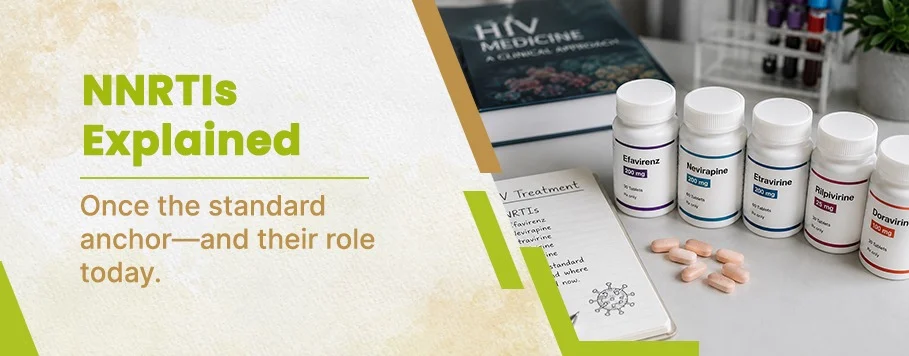
NNRTIs were once the standard anchor of HIV treatment worldwide. Efavirenz and nevirapine are the two best known members of this class. Their position has changed as integrase inhibitors have become the preferred option, but both medicines remain part of HIV care in defined situations. This guide explains what NNRTIs are, how they work, and where the class stands today.
NNRTI stands for non-nucleoside reverse transcriptase inhibitor, a name that distinguishes the class from the NRTIs that act on the same enzyme in a different way.
| Important note This article is general information about medicines used in HIV care. It does not include dosing instructions and is not a substitute for medical advice. All HIV medicines are prescription-only and are selected, started, and changed by a qualified doctor. |
Quick Summary / Key Takeaways
|
NNRTIs were once the standard anchor of HIV treatment worldwide. Efavirenz and nevirapine are the two best known members of this class. Their position has changed as integrase inhibitors have become preferred, but both medicines remain part of HIV care in defined situations.
NNRTIs are a class of antiretroviral medicine that blocks reverse transcriptase, the enzyme HIV depends on to convert and copy its genetic material. The wider framework of how classes fit together is explained in what is ART (antiretroviral therapy).
Both classes act on the same enzyme, but by different routes. NRTIs work by supplying a faulty building block that halts the copying process, as described in the guide to NRTI drugs. NNRTIs instead attach directly to the enzyme and change its shape so it can no longer function. Because the approaches differ, medicines from both classes can be combined.
| Medicine | Where it fits today |
|---|---|
| Efavirenz | A long established option, now used in defined situations |
| Nevirapine | Used in defined situations, including certain infant prophylaxis settings |
| Doravirine | A newer member of the class with a different tolerability profile |
| Rilpivirine | Used within particular combination regimens |
Efavirenz-based treatment was the WHO preferred first-line option until 2018. Guidance then moved towards dolutegravir, and updated recommendations in January 2026 continue to name dolutegravir-based regimens as preferred for both initial and subsequent treatment. The reasons relate to tolerability and resistance, as covered in the guide to integrase inhibitors.
Each medicine has its own profile. Efavirenz is associated with nervous system effects, covered in efavirenz: uses and side effects. Nevirapine requires attention to liver measures and skin reactions in the early weeks, described in nevirapine: uses and side effects.
| Myth | Fact |
|---|---|
| NNRTIs are no longer used at all. | They remain in use in defined situations decided by a doctor. |
| NNRTIs and NRTIs work the same way. | Both act on the same enzyme, but by different routes. |
| An established regimen must be changed immediately. | A regimen that is working well may be continued after medical review. |
| All NNRTIs share one side effect profile. | Each medicine in the class has its own profile and monitoring points. |
| The class can be taken without other medicines. | NNRTIs are used within a combination regimen. |
| When to Consult a Doctor Medical advice is appropriate before starting or changing any NNRTI, where side effects appear or persist, and where questions arise about whether an existing regimen should be reviewed. Support is available through HIV treatment and ART care. |
NNRTIs block reverse transcriptase by attaching directly to the enzyme. Efavirenz and nevirapine anchored HIV treatment for many years, and while integrase inhibitors now lead current guidance, this class retains a defined place in care decided by the treating doctor.
For expert guidance, TAAL+ Healthcare offers HIV treatment & ART care and a confidential HIV doctor consultation.
NNRTIs, or non-nucleoside reverse transcriptase inhibitors, are a class of HIV medicine that blocks reverse transcriptase by attaching directly to the enzyme and changing its shape so it can no longer copy viral genetic material.
Both act on the same enzyme by different routes. NRTIs supply a faulty building block that halts copying, while NNRTIs attach to the enzyme itself. Because the approaches differ, medicines from both classes can be combined.
Efavirenz and nevirapine are the best known, with doravirine and rilpivirine as further members. Each has its own tolerability profile and defined place in treatment.
Efavirenz-based treatment was preferred until 2018, when guidance moved towards dolutegravir. Updated guidance in January 2026 continues to name dolutegravir-based regimens as preferred, reflecting tolerability and resistance considerations.
Yes, in defined situations. They may be used where an integrase inhibitor is not suitable, within established regimens, and in certain infant prophylaxis settings.
Each medicine has its own points. Efavirenz is associated with nervous system effects, while nevirapine requires attention to liver measures and skin reactions in the early weeks.
Not automatically. A regimen that is working well may be continued following medical review. Any decision is made by the treating doctor.
No. NNRTIs are used as part of a combination regimen so HIV is blocked at more than one stage.
 +91 98925 15959

Before You Go
The HIV Test Kit Is Still FREE
A private HIV self-test, delivered in plain packaging. Result in 20 minutes, at home. No cost, no clinic visit, and a TAAL+ doctor on call whichever way it goes.
Offer valid only in India till 30 September 2026. T&Cs apply.